How to Make a Blowout Last Longer
A good blowout should still look good on day three. If yours collapses overnight, the cause is almost always something in the twelve hours after you leave the salon rather than anything that happened in the chair.
Let it cool before you go anywhere
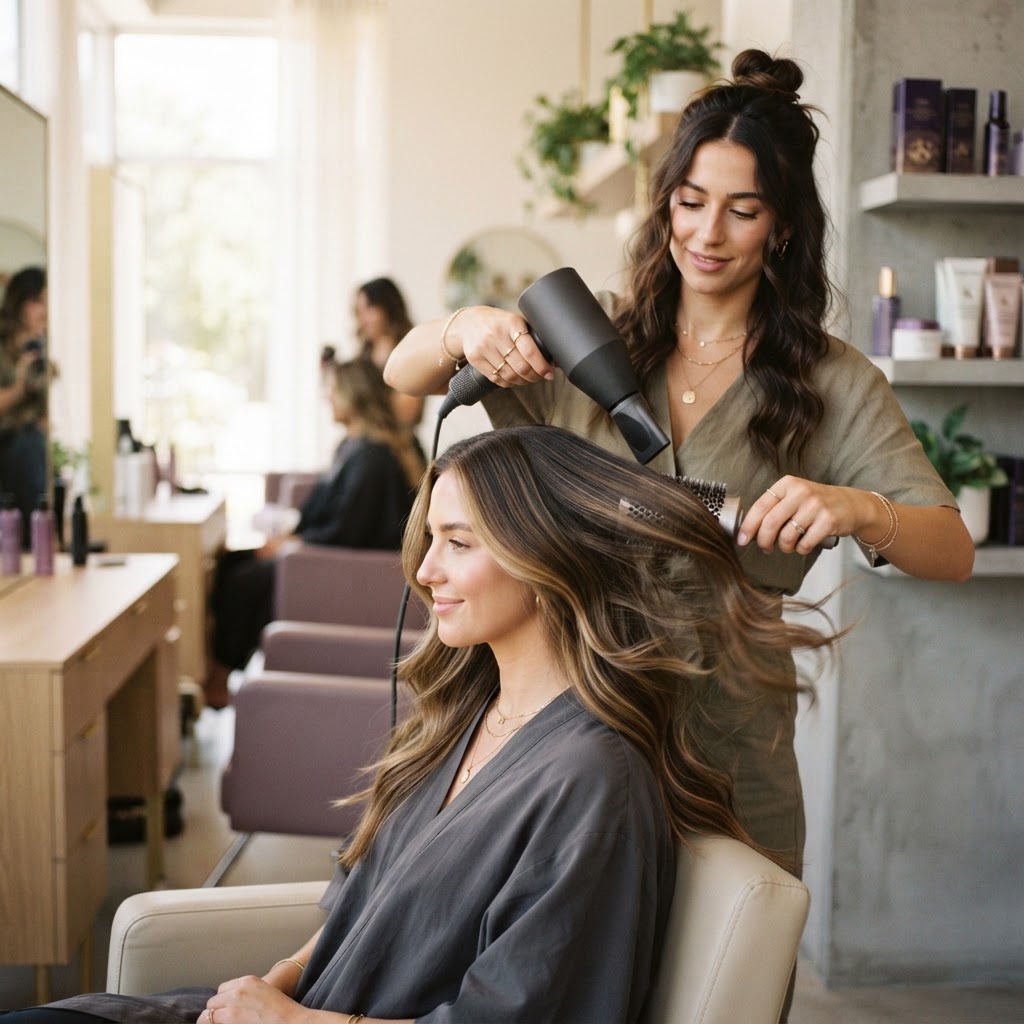
Hair sets as it cools. This is the whole principle behind blow-drying, and it's why your stylist finishes sections with cool air.
Walking straight out into heat, wind or rain while the hair is still warm undoes part of the set before it's fixed. Give it a few minutes. If it's raining, ask for an umbrella.
Don't touch it
Every time you run your hands through your hair you transfer oil from your fingers to your roots, and you break up the shape. It's an unconscious habit and it's the fastest way to flatten a blowout.
Notice it, then stop doing it.
Sleep properly
This is where most blowouts die.
On a silk or satin pillowcase if you have one — cotton creates friction, which creates frizz and flattens volume.
In a loose style. Pile the hair loosely on top of your head and secure it with a soft scrunchie or silk scrunchie, not a tight elastic. A loose bun sitting high keeps the weight off the roots.
Not damp. Never go to bed with damp hair after a blowout. You'll wake up with a shape you didn't ask for.
Protect it from water and steam
Water is the obvious enemy, but steam counts too. A hot shower fills the bathroom with moisture that will lift your hair's cuticle and undo the smoothness even if the water never touches your head.
Shower cooler, run the extractor fan, or shower before you'd normally do your hair rather than after.
Same logic applies to the gym, saunas and swimming. Sweat at the scalp is water.
Use dry shampoo before you need it
Most people use dry shampoo when their hair already looks greasy, by which point it's a rescue attempt. Used at the roots on day two, before the oil shows, it absorbs as the oil appears rather than trying to mask it afterwards.
Spray at the roots, wait a minute, then work it in with your fingertips.
Refresh rather than restart
By day three, the roots are usually fine and the ends have lost their shape. You don't need to wash and start again.
For the ends: a quick pass with a flat iron or a large-barrel tong on the mid-lengths, or a round brush and thirty seconds of heat.
For the roots: dry shampoo, then flip your head upside down and shake.
For frizz and flyaways: a tiny amount of smoothing balm warmed between your palms, or a light mist of shine spray. Mid-lengths and ends only.
For shape: a flexible hairspray you can brush through afterwards, not a firm one — you want to reshape it tomorrow too.
Products that help
Before drying: a blowout lotion that protects against heat and cuts drying time. If you blow-dry regularly at home, heat protection is the most important product you own.
After drying: a light finishing spray or shine spray. Serum works too, but sparingly and never near the roots.
For day two and three: dry shampoo and a smoothing balm. That's the whole maintenance kit.
And a few habits that shorten every blowout
- Washing your hair more often than you need to
- Tight ponytails and hair ties that dent the hair
- Hats
- Running your hands through it, again
- Going to bed with it loose
None of those are dramatic. They're just the difference between two days and four.
At home
If you blow-dry your own hair, the things that make the biggest difference are working in proper sections, using a round brush with tension rather than just blasting heat at it, and finishing every section with cool air before moving on.
That last step is the one most people skip, and it's the one that actually sets the shape.